Why do some fictional worlds feel chillingly real, even with demons and dragons? It’s often because they portray a different, more subtle kind of monster: prejudice.
In DnD or any other TTRPG, roleplaying the cartoonish villain is easy.
Low-key cruelty and bigotry: the Elf-hating Dwarf, the xenophobic shopkeeper – those need a closer look.
This is a topic which is nuanced:
Prejudice in the real world is a bad thing.
Including prejudice in your games CAN be a good thing.
You can tell stories which are more subtle, more satisfying to resolve, and may just resonate long after the dice have stopped rolling. Today we’re going to look at the big questions around roleplaying prejudice in TTRPGs,
I’ll show you how as DM in DnD or GM in any other system, you can bring prejudiced groups or individuals to life in a way that doesn’t feel… icky.
I’ve also got a toolkit to help you introduce this topic to your table, and a guide on how you can play prejudiced characters as a player and GM, with sensitivity and respect for everyone.
The Fundamentals
I’m defining prejudice as an irrational suspicion or hatred of a particular social group. In our world that’s often people of different races or the adherents of a religion.
For the sake of not using a single word so often that it loses all meaning after a while, I’m going to use it interchangeably with the word bigotry. It’s not quite a synonym, but very close. Bigotry is actually a stronger form of the word prejudice.
But for this post, when I use one, it can just as easily be interpreted as the other.
Also, for the avoidance of any doubt:
PREJUDICE AND BIGOTRY IN THE REAL WORLD ARE BAD THINGS.
You can totally bring prejudiced characters to your games of DnD or any TTRPG. If you’re an experienced player or GM, I bet you’ve already tried it before.
I really hope it’s gone well for you.
I hope you’ve navigated the separation between real person and your character.
I hope you’ve found the right path away from casual cruelty and towards a more nuanced, believable position.
I hope your characters have grown – that they’ve changed and evolved as the story has unfolded.
Because if we get this wrong, things can go bad, fast.
If we’ve offended someone, saying “I was only playing” is not going to cut it.
What we need is a framework on how to present prejudice in a sensitive way.
“But Rich, who are you to be lecturing everyone about prejudice?”
Excellent question, oh hopefully hypothetical person!
Through no skill of my own, I’m a straight white male in my thirties, living in Scotland, a country which has a majority of white people. This means that my experience of prejudice is on the whole, indirect. I’ve heard stories from friends, and read books and consumed media about other people’s lives which I’m then able to take in and find empathy with them.
If being on the receiving end of prejudice is also outside of your lived experience, congratulations, you win yet another prize.
But it’s also on you to learn about people’s lives outside of your own community and do the work to make sure your words and actions, whether intentional or not, avoid harming others.
The big questions
Should players play prejudiced characters?
Yes, if everyone around the table agrees.
What you do at your tables is not for anyone else to police.
At my tables, I allow prejudiced characters, on the condition that it’s not their entire personality, and the player is open to them growing and learning as the campaign progresses.
I’d also allow a player character to become prejudiced due to events that take place during the game. Maybe we have a Human Fighter come home to the edge of the forest to find their village ablaze. All they’re able to find out is that it was destroyed by Elves.
That character might become prejudiced against all Elves, and that’s not a great response, but it’s one we can understand the motivation behind. Then in the next few sessions the character would behave very negatively towards any elves, regardless of whether they were the ones responsible or not.
What I’d want to see from a player in that case would be for them to look for ways to confront that prejudice in the character. Maybe as the game progresses they find out that it was a certain band of Elves that did the horrible deed, and that most Elves live peaceful lives.
I’d be looking for the player character to realise their viewpoint wasn’t reasonable. When this new information comes to light, I wouldn’t feel great about a player insisting that their character saying things like:
“I just hate them, always will”
That’s where at my table I’d be drawing the line and looking to make a change.
In this scenario, I’d make a point after the first session it came up to check in with the player and the rest of the group to make sure they were ok with the direction this character was likely to take.
Is everyone ok with inter-species prejudice?
If not, we can always change things to suit everyone’s preferences. Maybe it wasn’t Elves after all, we could retcon and say it was a band of Humans instead – the same species as our player character. More on retconning later.
Should GMs play prejudiced characters?
Yes, again, if everyone around the table agrees.
All tables are different, but when I’m running games, I want those characters to be fought against and challenged by the players during the course of the campaign.
That bigoted city guard? I want my players to ruin her day.
The xenophobic tavernkeeper? Hells yeah I want my players to unleash the rats in the basement all over his bar and drive away his customers.
I personally don’t want to run or play games where prejudice isn’t challenged, and hopefully eventually overcome. Games which are hopeless, games where the world is utterly bleak just aren’t my idea of fun. Even Mork Borg gives some hope that all is not lost.
If your preference is to play games that dwell in that dark place where forces of evil are truly unbeatable, then have fun, but I’m very unlikely to join you at your tables.
What about Evil Campaigns?
Evil campaigns are a lot of fun.
We get to play as monstrous people doing bad things.
There is something VERY satisfying in getting the opportunity to be bad. When you’re looking to run an evil campaign for yourself, you’ll have an easier time if you lean into the cartoonishly evil, rather than the morally dubious.
Remember that both Team Rocket in Pokémon and Doctor Robotnik in Sonic are evil, but still very much family friendly.
But those are for kids, what does a more mature evil campaign look like?
I watched Dimension 20 – Escape from the Bloodkeep recently.
Those characters are EVIL… but we love them. Why is that?
It’s because their personal flaws – their deep personal flaws in some cases – are about the characters desire for power and control and petty ambitions.
When Matt Mercer’s character, Leiland decides to have a vendetta against Galfast Hamhead, the legally distinct Samwise Gamgee, it’s not because she’s a Halfling (definitely not a Hobbit) – it’s because she has thwarted his plan in the Scary Volcano.
The character hates one VERY SPECIFIC Halfling, not all of them. So this character can still be evil and do dreadful things, but it’s indiscriminate violence, rather than aiming at a particular group. If you want to run an evil campaign, I’d recommend this approach, rather than adding prejudice into an already complex mix.
What about Orcs and Ogres and Oozes (oh my!)?
Prejudice is unfounded IRRATIONAL suspicion and hatred. Lots of antagonists in RPGs were created by the designers so that players can RATIONALLY beat up some baddies and not feel bad about it.
Over the years, fans of worlds and authors have humanised and softened creatures which were once just monsters, to become something more complex.
“What if not all Drow are evil?” is how we got the Drizzt (Drist) novels.
You can even get cuddly Gelatinous Cubes now. They’re objectively adorable, you should get me one for Christmas.
As a rule of thumb, if they do people things, they’re people, and you shouldn’t kill them unthinkingly.
If they do animal things, they’re animals, and you also shouldn’t kill them unthinkingly.
Remember, a good definition of cruelty is needlessly causing harm.
If they don’t have either of these behaviours then have at it.
Go to town killing skeletons and demons and monstrosities if you like.
It completely depends on your setting, at YOUR table.
Who run the world?
Well… girls obviously.
But if you’re not a girl, it’s still you.
You decide what happens at your table.
Not me.
Not Wizards of the Coast.
And as long as you preface your game tales with “in my world” or “at my table”, rather than “In the canonical Forgotten Realms”, we can all have a good time on the internet.
Why it’s difficult to play a prejudiced character
Hurting people – even imaginary ones, isn’t nice
One reason it’s tougher to play a character who’s prejudiced is because their views and actions will directly hurt others, and by nature of prejudice, disliking whole groups, they’re going to be hurting innocents.
Given that you’ve been reading a philosophical article about prejudice for the last few minutes, I think I’m on pretty safe ground when I assume that you’re, on balance, quite a nice person.
You’re not well practiced at being terrible, and being mean to people doesn’t come naturally to you. This means that unless you’re an actor, you’ve not really tried to upset people on a regular basis.
It makes us look bad in front of our friends
However deeply immersed in our characters we are, everyone we play is still in some way… us.
And it’s natural to worry that the folks we’re playing with won’t be great at making the distinction between who our character is, and who we really are as a person.
Look at Jack Gleeson who played Joffrey Baratheon in Game of Thrones.
He got hate-mail from people who so despised his character, they took time out of their days to write to write horrible things to him.
Unless you’re running Actual Play your audience is going to be your friends around the table.
But that makes it worse.
These are your friends! – people who you care about, and you value their opinion.
This is yet another barrier to playing a flawed character – and that people-pleasing side of us, may mean that we never take that risk at all, playing it safe with bland, flat characters.
What to do at the table
So how do we actually do it?
How do we bring a flawed, prejudiced character to our table?
I’ve split this section into actionable tips for everyone, then Player specifics, finally looking at guidance for GMs, which includes tips on worldbuilding, as well as making individual characters.
Also I’ve made a summary document for this post with these tips front and centre, which is a free download on the Renegade Rolls Patreon.
You don’t have to be a member to get it, but if you’d like to support me and this channel, I’d appreciate it.
Everyone:
Trust and love
In order to reach the upper levels of a great game, you’re going to need to do two things:
You’ll need to trust and love the other people around the table.
If you prefer to sound corporate rather than all new-age spiritualist, you can call it a Social Contract, but it boils down to the same thing.
It’s about knowing that your fellow players are not their characters, and feeling confident enough in your relationship that you can call each other out if you’ve gone too far, without it bleeding over into resentment between you as people. That might be chatting out of character about the direction you are planning to go.
This might be saying “hey my character is probably going to confront yours soon – just a heads up that it might get a bit heated in the moment”.
Stop if it doesn’t feel ok
Professional actors struggle with playing evil characters.
I’m not a professional actor, you’re probably not a professional actor, so it’s completely ok to stop, Pause for a Second, use the X-Card or any of the other safety tools at the table, and take a minute to step outside of the character, and check back in with yourself before continuing.
There’s a good line that’s been added by the government to gambling adverts here in Scotland: “When the fun stops, stop.” and that advice holds true for us playing TTRPGs as well.
Also having a debrief after a particularly heated session is incredibly useful before you go your separate ways. It’s a moment to decompress, and to realise your friend is still your friend, and not the character which they were playing for the evening.
Retconning
Retconning is great.
I do it all the time as a GM, and players should totally have the power to say “hey, actually can my character have said that instead?”
It doesn’t break the game, and can be used for all sorts of purposes from:
“oh I forgot I have a skeleton key in the Bag of Holding, can we retcon?” to
“yeeeah I don’t feel comfortable with what my character said there, can we retcon?”
Allow it, normalise it, and everyone will have a better time.
Find the why
For a masterclass in finding the why, I’d going to refer to… myself, and my wonderful players.
Here’s a section from one of my Actual Play videos.
We were playing a Halloween Reverse Scooby-Doo game where the players were all g-g-g-ghosts, ghouls and things that go bump in the night.
Dominic was playing the ghost of the park manager, who was just too busy to pass on, and he’d set his sights on trying to spook the (legally distinct) Velma character, that I’d cleverly called Thelma.
(if the timestamp trick doesn’t work, watch from 01:06:12)
You can see he was clearly flustered with the sudden accusation, but did a great job in thinking on his feet to give a reason why his character would act this way. We did a quick check-in after this to make sure everyone, especially Dominic felt ok with it.
As GM, I felt they were just on the right side of where I felt comfortable.
If I’d felt they’d gone too far, I would have stepped in. Also, while funny, this was BAD BEHAVIOUR by the rest of my group. The trouble is, we all do improv comedy, and this sort of “gifting” is the sort of thing we’ll do to each other out of mischief.
If you want to practice “finding the why” there’s an improv game called Accusations where you say outlandish things like:
“Hey Rich, why do you believe that the moon is plotting to kill you?”
…and the other person has to defend themselves, owning the accusation:
“I do – I really do… I see it out there – never the same shape, changing all the time – but sometimes with a face, never blinking – just the cold staring dead eyes of a killer. It’s behind me again isn’t it?”
Avoid making it their whole deal
Remember – most people think they’re acting entirely logically – they’re the heroes of their own story.
And it can take a lot of effort to shake this worldview.
I’ve spoken before in videos about how one-dimensional characters are dull.
A totally single-minded character might be easy to roleplay:
“what’s that Thiefy McThiefface? You want to steal from the merchant again?”
Buuut it’s going to wear thin pretty quickly. This applies tenfold when it comes to portraying a prejudiced character. If that’s all they’ve got to say for themselves, well it’s not going to be a good time for anyone.
Instead, make sure that it isn’t their whole deal. They can have other things about them. The most affecting villains are the ones who are relatable 90% of the time, and then surprise us with a callous action.
Is a scene it occurs in adding to the story?
There’s a rule in screenwriting which says that any scene which doesn’t progress the story in some way shouldn’t be there. Gratuitous-anything in media is likely to be a turn off for me. It’s where the point has been made, but they just keep on going, showing more examples of the bad thing. It doesn’t aid anyone’s understanding.
You should bear this in mind when you’re portraying a character who displays any sort of prejudice. Once you’re sure folks around the table get it, there’s no need to keep reminding them at every opportunity. You can revisit this behaviour in a few sessions if you find that others around the table have forgotten about it.
If there is a scene which is yet another example of the scummy character being scummy, you can always draw a veil over it, and move on to another scene.
Lines and veils are one of many safety tools that I highly recommend you look into if you’re not using them already.
Players
If you’re a player in a game where your group has agreed to explore prejudice and its ramifications, I’ve got three key pieces of advice to share.
The goal is to grow
If they’re able to defeat the big bad evil person in the process, all the better.
First, the goal of any player character in a long term campaign is to grow and change. At least if you’re playing a game with narrative-first, rather than a completionist, or simulationist group. The differences between those types of play are something I could spend a whole video discussing, but for today, we’re looking at narrativist style games.
It’s easier to play a character who’s predilections only hurt themself. The alcoholic, the kleptomaniac. Often they can illicit sympathy from other characters especially when you find out the root cause of this behaviour.
It might not take long for a person to realise that shouting abuse at people different than them is a bad thing to do, but it might take longer for their suspicions to relax completely.
Pressure fellow party members
If you’re playing alongside a bigoted character, I’d hope that your character would “have a word”, just like I hope you’re able to have a word with any bigots in your life. These moments in game can lead to fantastic, deep roleplay moments, and can often be the catalyst for change in a character, but, just as in the real world, the social costs of calling out bad behaviour can feel just too high, so have a think about whether your character would feel able to call their teammate out.
I’d recommend a bit of a fourth wall break to share a little of your character’s internal monologue as a way of making it clear that they feel uncomfortable with a situation, but just aren’t voicing it. It’s a good way of letting everyone around the table know that you’re aware of the bad behaviour, but have an in-game reason for not confronting it.
1st Person vs 3rd Roleplay
Seth Skorkowski made a video recently which I’ve linked to in the description on Closed vs Open roleplaying, all about character secrets. He shares some great wisdom there, including a section in there which was all about when to narrate in first person, and when to narrate with a third person viewpoint.
You can distance yourself from your characters actions, especially if they go against what you the player think by moving away from a first person voice, and into a third person perspective.
Instead of saying directly:
“I’ve never trusted Tieflings, once from the hells, always from the hells”
You can say:
“Hammer Hammerson looks at the approaching Tiefling and tells everyone loudly that he doesn’t trust them”
It’s a small difference, but can make help make things a bit less intense, if you know your group don’t want to lean in too closely to this sort of roleplay all the time.
DMs & GMs
You can use all the advice in the players section and apply it to your NPCs, but if you didn’t already have enough on your plate, here are some more things for you to think about – in your pre-game worldbuilding and at the table. You might feel that not all of these suggestions suit you and your group, but that’s ok – you’ll find what works for your table.
Show that there are systemic issues that inform personal behaviour
Ignoring people who are just thugs and want to hurt people, the route which leads to people sharing prejudiced views is usually down to ignorance. Someone has been told that the groups of people act a certain way, and they have no counternarratives to give them an opposing viewpoint, so they go along with the prevailing wisdom. This is likely to be most of the prejudiced folks you should set up for your player characters to encounter.
Our regular fantasy worlds are large, and people would likely not be exposed to other cultures in the way that we have access to in our world today, so that narrow outlook, that distrust of the Other, while not right, is at least understandable.
The other sort of person sharing prejudiced views is more insidious, where someone has access to the facts and knows that a prejudiced view is not logical, but chooses to be cruel regardless, sharing lies and disinformation.
To drop the fantasy façade for a moment, in our world these groups are both readily apparent:
Cold calculating people have realised that it’s in their interests to tell groups of people who have grievances, and feel left behind that their enemies: the people who are making their lives worse are the other, the outsider, the immigrant, the person who is somehow different to them because of religion, heritage or sexuality.
“Yes this is why you feel like you’re not getting ahead in life. That person wants to eat your only cookie”
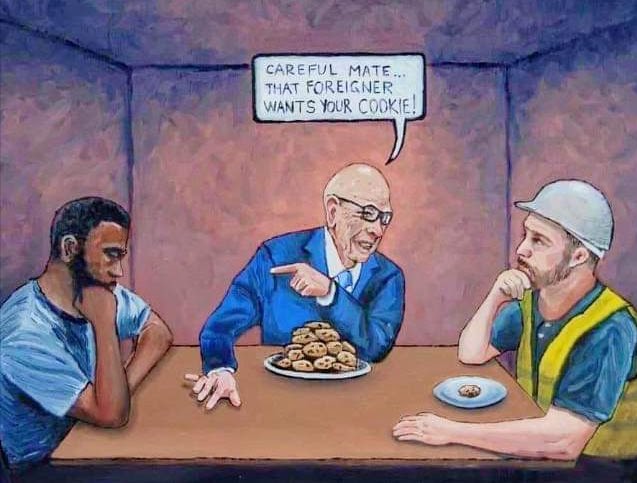
…while they horde a million times more cookies than you can ever have access to. And these people control the mainstream media, social media, and an increasing number of the political class. Sadly, there’s no shortage of real world inspiration you can bring to your games.
It’s going to be up to “our heroes” (that’s you btw!) to see through the deception and defeat this true enemy.
Demonstrate that society allows this sort of behaviour
You’ll need to decide how entrenched you want prejudice to be in the societies that you present. Are there just a few bad apples, or does the rot go right to the core?
I find these sorts of worldbuilding questions fascinating.
Can you have a good empire?
How about an evil federation?
Whatever you decide, you’ll want to demonstrate what “normal” looks like for each locale: are cities civilised and cosmopolitan while more rural areas are less welcoming? Or would urban areas be closed off, to all but a chosen “in crowd”
The choice on how much, how little, how isolated or how widespread prejudice runs in our worlds should be a major point of consideration when deciding the overall tone of your campaign. It’s something I’d look to share with my players as early as possible – in a campaign elevator pitch, before anyone commits to playing.
Give opportunities to confront, or let your players stew
I mentioned in the section for players that they should be looking for chances to confront their fellow party members, and call out bad in-character behaviour when they see it. As GM you can do a lot to facilitate this.
Give the questionable character opportunities to be bad, and make sure you make time for quiet moments in between combat or social encounters with NPCs for some one to one time between player characters. Less is more with this kind of thing.
You can simply say:
“The two of you take the first watch together. What do you talk about as you watch the first stars come out over your campsite?”
Your players will hopefully go “ah ha – roleplay time” rather than “uh we talk about how beans are getting boring for dinner every night”.
Depending on the length of your campaign, as a group, you may also want to let resentment between the PCs fester for a few sessions. If your group are up for it, let the characters stew an uncomfortable dynamic. Again, not your players – if your players are uncomfortable, something has gone wrong.
Slugblaster does this well in making the uncomfortable moments into a game mechanic. Each character has an arcs, which it costs in-game currency in order to progress through, so the group are encouraged to really revel in the awkward moments of a falling out, and shouldn’t be able to resolve things happily until they’ve spent some time in each phase of their story.
For some folks this could feel a bit prescriptive, but if your group are looking for some structure to their character stories, this game might be right up your street. If you want the full rundown, go watch the Quinn’s Quest video on Slugblaster – absolutely brilliant stuff.
Present dilemmas – the lesser of two evils?
If you REALLY want to twist the knife, one of my favourite tools is to play a game of The Lesser of Two Evils. Give the player characters choices which put them on the side of the prejudiced NPC while you fight a common foe.
The NPC Cleric is a massive xenophobe, but she’s the only one who can Turn Undead and keep the skeletal hordes from overwhelming the town. Will the characters take her up on the offer of assistance, or try and fight the unquiet spirits on their own?
If you pitch it right, they’ll take her up on the offer, and the characters (not the players!) will HATE every minute of it. That’s a good short-term example, but there’s a diabolical artform in stringing this out across many sessions, making it a theme of the campaign: moral greyness and compromise.
Don’t do this in a heroic heroes heroing heroically game of DnD or a My Little Pony game, but in something like Into The Odd or a DnD game where you’ve agreed to explore more nuanced characters, this dilemma of the lesser of two evils would fit right in.
Putting it all together
Let’s review, and see all of this together.
First, I believe that we can have prejudice in our fantasy worlds, and if you’ve read this far, you probably agree. For me, it’s OK to include prejudice in a player character, in NPCs, and societies as a whole – as long as it’s handled sensitively, with trust, love, and in a way that respects everyone’s safety.
I expect a lot of people find it difficult to play prejudiced characters, because quite frankly, it doesn’t feel nice, we’re not practiced at it, and we don’t want to make things weird with our friends round the table.
But if we can push past that, again with sensitivity, trust and love, then yes we can bring prejudiced characters to our games.
Everyone
These tips apply to everyone, players and the GM:
- We play with trust and love. Always, even if saying it like that feels odd.
- If it doesn’t feel ok, we stop. We take a break, and check in with each other.
- We’re not afraid to retcon, and use it as much as we need. The consistency of the narrative is less important than our friends.
- We “Find the Why” for prejudiced characters, and we make sure that they’re not one-dimensional, bigotry should never be someone’s entire deal.
- We only include scenes depicting prejudice which actually add to the story. We’re not gratuitous.
Players
- The goal for our characters is to grow. In my games, I want to see PCs overcome their inner demons, so they can take on even bigger foes… like dragons… or billionaires.
- If we’re playing in a group with another character who is prejudiced, we look for opportunities to confront them, or give in-world reasons why our character might not be up to the task right now.
- If things are feeling a bit intense, we can pull the camera back to a third-person viewpoint. It’s “my character does…” rather than “I do…”
GMs
- We distinguish between ignorance and true malevolence.
- We build worlds that make it clear just how prevalent prejudice is – it should be a major component in colouring the overall tone of our campaigns, and shared with our players as soon as possible.
- We give opportunities for the PCs to confront their comrades, and the bigger injustices, but we choose our moments – depending on the feeling at the table.
- We present dilemmas for the characters – finding ways of giving them tough choices with potentially no perfect outcome.
A PDF as well as a markdown version for all you Obsidian fans is available as a free download on my Patreon
No need to sign up, but if you’re feeling generous, I’d appreciate the support.
If we can do even SOME of the things I’ve listed here, then discussing prejudice at our DnD tables shouldn’t be a taboo we steer clear from, but something we can address head-on, with confidence that we’ll be able to tell deep, nuanced stories with our friends that can stay with us for a lifetime.