Is Daggerheart the best tabletop role-playing game for beginners? Well, the too-long-didn’t-read for this post is, in my opinion, very nearly yes. And I would highly recommend it for new players and game masters, but it’s a nuanced answer and it will take a bit of explaining.
I’ve played and run a load of TTRPGs, including lots of games with my favourite subset of humanity people who have never played before, but are curious to give this weird and wonderful hobby a go. If that’s you, then hi there, welcome.
What happens when folks who are brand new to the hobby and have never rolled a funny-shaped dice in their lives before try and play Daggerheart? I found out with a little help from some friends.
I ran a one-shot, a self-contained adventure over the course of one session, which you can watch in its entirety on my brand new channel, Renegade Rolls TTRPG Actual Play.
My plan is to have videos for Actual Play in Daggerheart and a load of different systems on that channel, with my regular GM advice on the existing one. Updates from both will be posted here to browse to your heart’s content.
My Players’ Preconceptions
Before they sat down at the table for the first time, I asked my players what were their hopes and fears about trying a role-playing game, and I suspect that if you are brand new to the hobby as well, then their answers might resonate with you.
Jack
My hopes for it is that it’s going to be fun, it’s going to be like having fun with just a group of pals, coming up with stuff, making each other laugh, making interesting stories together. If that’s achievable, that’s going to be great.
That’s a great new hobby that I’d love to be a part of. But yeah, still not convinced it’s not a trap. So we’ll see.
Kay
My biggest hope for this game is to improve my improv skills, but also have a lot of fun and just get better at playing these sorts of games. And then I would say my biggest fear is just completely not knowing what’s going on. I think that would be it.
Joseph
My biggest hope for this game is that I will be able to have fun with a nice group of people without really having to learn a lot of rules which will take me out of the storytelling aspect of the game, about bringing a character to life.
My biggest fear is that it’s going to be very distracting when it comes to how to learn those rules. I don’t particularly do well with having to memorise a lot of different moving factors.
Emily
My biggest hope is that I really, really get into it, just play it every weekend and never stop. And my biggest fear is that it will be very, very long and very, very boring. And then I would have just wasted a Sunday doing something I hate when I could just be watching Doctor Who.
The GM’s Perspective
It’s not just about new players. If you are new to the hobby but excited about all the possibilities, you might find that you gravitate towards being the Game Master, or GM for short, running a session for your players. On this site I’ve got a load of advice on running TTRPGs from deep philosophical dives for veterans to introducing the hobby and some core GMing principles for newbies.
I’ve been running games for 7 or 8 years now so I don’t fall into that category of new Game Master, but looking back there are a couple of things I’m glad I found just as I was getting into the hobby.
Firstly, finding rules and systems for playing which are well structured and easy. This allows you as Game Master to think about other stuff, to focus on spinning all of the other plates you’ll need in order to run a good session. The other thing when I ran a game for the first time is that I was really, really hoping that it wouldn’t be weird:
I’d get all my friends to come over and I’d be really excited but they’d just look at me and go “huh?”
If you’re new to roleplaying games, it’s likely you’ve heard of Dungeons and Dragons. That tends to be the game that most people have heard of, thanks in part to Stranger Things and the Big Bang Theory as well. But when you’re thinking of getting into roleplaying games like this, it’s a bit like learning to drive:
The car that’s going to be best for learning on is not going to be the top notch sports car. Both get you from A to B but the learner car, that little 3-door hatchback is going to be a lot more forgiving of mistakes and you’re less likely to find yourself upside down in a ditch with everything on fire.
What I look for in a game to play with new folks is very different to my criteria when playing with an established group.
Rich’s Criteria for Games for Beginners
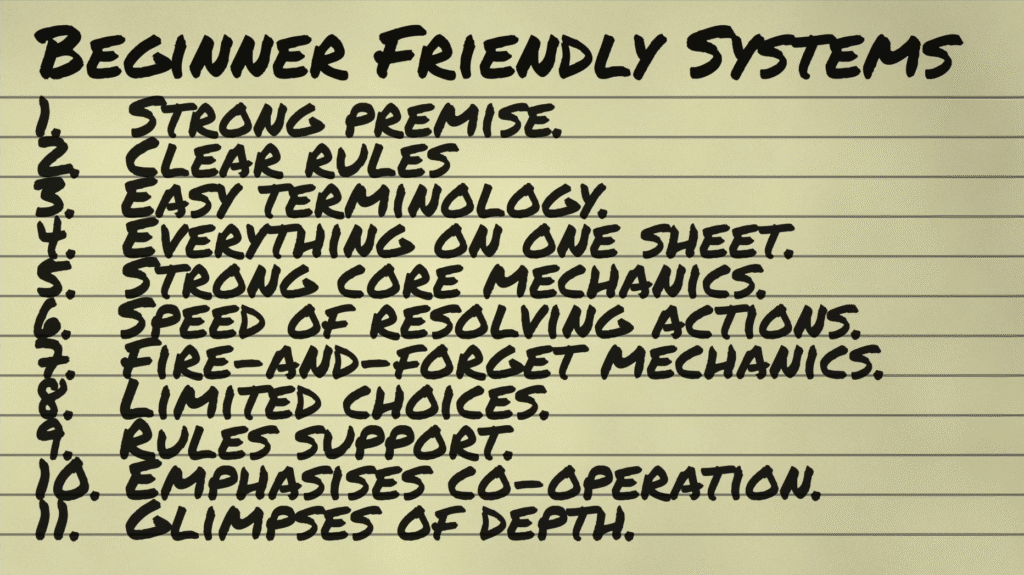
To distil down what I’d like to see from a player’s perspective as well as from the game master’s side, I’ve made a bit of a list.
First up, I want to see a game with a strong premise: You are heroes, heroically fighting the forces of evil. You are survivors on an abandoned spaceship. You’re a group of little old ladies solving crimes. You are three goblins in a trench coat, up to cause mischief.
With that in mind, the next thing that’s very important is that the rules are clear and that there are resources and some backup when you need it. Dungeons and Dragons does this very well with a wealth of online resources but lots of other systems are catching up in terms of support and how you can learn to play those games.
Number three, minimal terminology. It’s bad enough if in-world there is prestidigitation and gambeson armour, which you might not have heard before, but if the system itself is adding load of terminology into the mix, it’s going to be overwhelming.
To minimise the overwhelm, so you can just be whelmed for a change. I really like to see everything on one sheet in front of me. For players, that means a character sheet and a rules explainer. And for game masters, a little cheat sheet with everything you might need to run a session. Spoiler alert, Daggerheart does this so well.
Nextly, strong but not necessarily simple core mechanics. I don’t mind rolling a couple of dice and adding a modifier and things, as long as that is something consistent, which is repeated throughout the game.
I’m also looking for the speed at which actions are resolved. Having to roll a dice and then do a ton of maths afterwards to figure out whether I hit or miss or what happens next can lose momentum from a game.
The next couple are slightly technical from a game design point of view, but I love to see them.
First, fire and forget mechanics. The character does something in the world. That change happens and we get on with our day. Lots of games like saying “oh, everyone now gets plus one to these rolls until this next condition is met”. Trying to remember that on top of everything else in your first session ever is just adding yet another plate to have to spin.
A system that says “the only limit is your imagination” is going to be tricky. If you’re brand new to the hobby, you don’t know where the borders lie, you need a bit of guidance. On the player side, that means limiting choices so you avoid the decision paralysis demon of having different things you could potentially do on your turn and not knowing which one is best.
So with that in mind, I want to see rules support for each of the pillars of play, which is relevant to the system. Not all systems use combat, but where that’s a part of the game, I want to see it well supported. Likewise for exploration and investigation, as well as the social side.
Speaking of the social side, games which lean into the cooperative aspect of helping players help each other is something I love to see, because it gives new players a window into what these games can be. A collaborative game where we all make the story together.
This leads into my final wish for a beginner-friendly system, which is to show some glimpses of the depth of the system and the depth of the hobby in general to help get people hooked. So they can go from being a newbie to spending way too much money on books and dice and all the associated stuff.
In all seriousness though, there are lots of games and systems you can play for completely free, including the core rules and systems for Dungeons and Dragons and Daggerheart and loads of other systems. So while all the books and things are nice, it doesn’t have to be an expensive hobby if you don’t want it to be.
The Tier List
It’s time for that tier list! Based on those guidelines, from worst to best, here is where I rank each of the systems I’ve run a session for on how well suited I think they are to beginner players and for GMs. This is not a list of the games I think are best overall, or the games I choose to run week to week. This is just how I rate each game, as a starting point to get into the hobby for beginner players and beginner game masters.
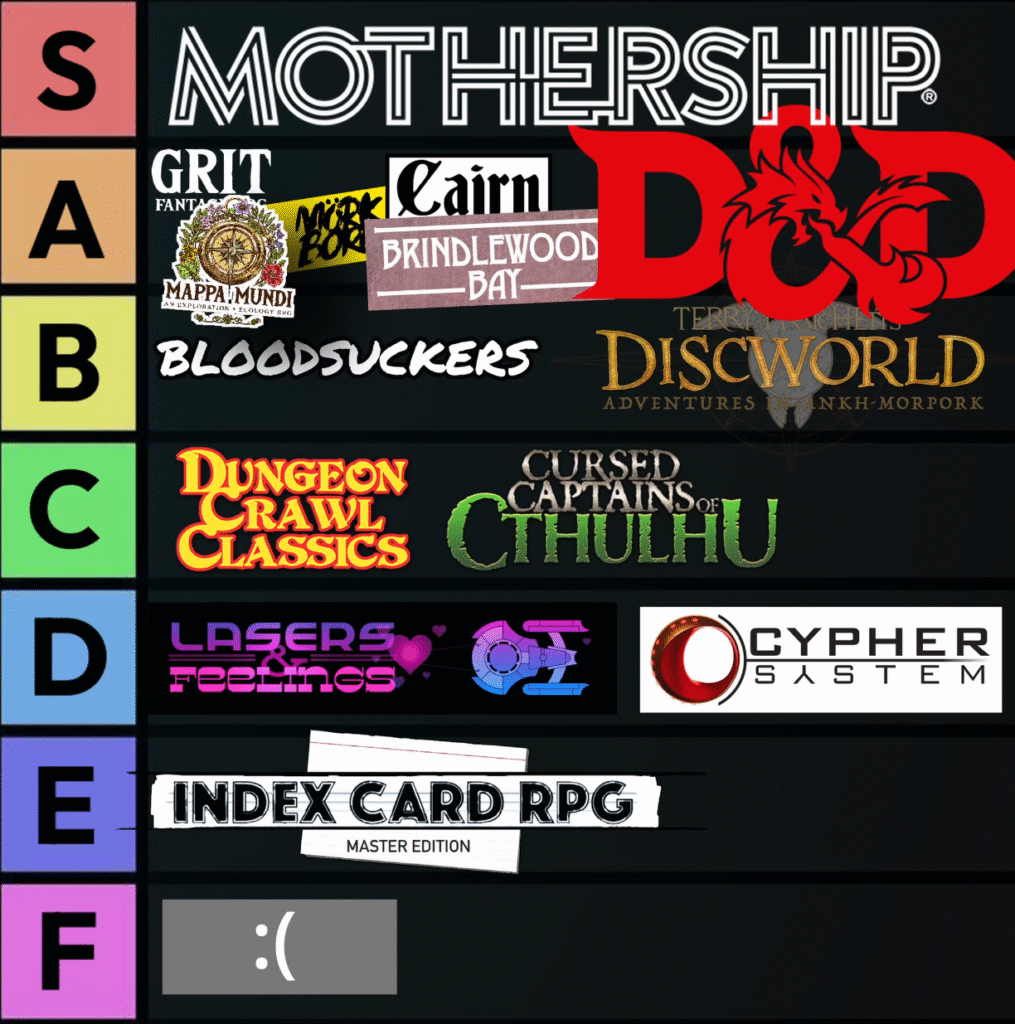
There’s a bonus video over on my Patreon where I break down why each game is where it is in the rankings. You’ll notice that the Big Beast, Dungeons and Dragons is in A tier there, and Lasers and Feelings, which I love as a system, is down right there in E tier.
For me, Mothership sits at the very top of the tree. The character sheet is amazing and there are simple mechanics for everything. It’s also got the clearest of premises. It’s like Alien. You are a group of regular folks in space just trying to survive. Let’s go.
But this post isn’t about them, it’s about Daggerheart.
Where does Daggerheart Fit?
As a game for beginners, I think that Daggerheart comes incredibly close to reaching that very top tier there, but I’m going to put it in A tier. It is very, very good.
I think on balance, slightly better for beginners in Dungeons and Dragons. Specifically for beginner GMs. I’ll start with the positives, but there are one or two things I would have loved to have seen done differently. One of those are dealbreakers for me, but they could be for other people. Starting with the good stuff.
The onboarding to Daggerheart is a delight. If you’re sitting around a table making characters together, the beginning steps aren’t so different to what you might see in other systems, but something that really shines for me is how they bring in character connections. How they encourage the group to form a bond together from the very beginning. There is no risk whatsoever of starting in a tavern and going:
“Oh, I don’t trust these people. Who are they? Why should I adventure with them?”
Instead, if you’ve gone through all those steps of character creation, you have a group that feels ready to fight for each other.
And I love some of the specifics of the character questions:
“What mundane task do you usually help me with off the battlefield?”
“Why do you act differently when we’re alone than when others are around?”
“Why do you grab my hand at night?”
For onboarding, for starting a game, I like how natural a language is. There aren’t many odd words.
Though if you’re brand new to roleplaying games, good luck saying prestidigitation for the first time.
The most stressy time for players and for game masters is during combat, when there’s time pressure on your choices and a bad decision or missing noticing a useful character or ability could be the difference between victory or defeat. For players, having the character sheet surrounded by cards makes everything easy. It’s very physical, it’s very tactile and nothing is hidden away in a rulebook.
In fact, when running my actual play one shot, I only looked into the rulebook once. For 99% of the session, it stayed closed on the table next to me. Between the game master’s screen and the one page guide, I had everything that I needed. When I was controlling the enemies, everything I needed to run an adversary was all in one place. There was no page turning looking for spells or different abilities, everything was just there right in front of me.
Small side note, I really hope Darrington Press releases a deck of adversary cards, ideally with boxes of hit points and stress that can be filled in. Multiple sets of boxes on a single card for some of the common foot soldier type adversaries, as well as dry-erase would be amazing. You’ll have a very happy customer here.
Anyway, the system is a little bit lighter than Dungeons and Dragons. There are only three conditions and two damage types, but it’s no less strategic. When running it, I didn’t feel like I was missing any nuance or any of the crunchiness.
Something which is genuinely very important to me is Daggerheart is fantastic on safety tools and inclusivity, right in the core of its design. Within the fiction of the world, everyone can communicate in sign language, and there’s also a combat wheelchair.
Spellcasting which can be particularly complex in lots of different game systems in Daggerheart doesn’t feel overwhelming at all. In fact, it’s no more complex than any other character class.
In some games, I’d recommend “play a fighter player barbarian if you want an easy time.” In Daggerheart, each class is as simple or complex as any other one. As a player, you are free to follow your imagination, to choose whichever you think would be a compelling character.
One of the negatives when it comes to simplicity is there are four different things that need to be tracked in Daggerheart from a player’s perspective. There’s hit points, there’s stress, there’s armour, and there’s also the hope slots as well. So there’s a bit of work every time to make sure that your sheet’s up to date. That means it’s a game where you’ve got to be paying attention, and it’s maybe not suited so much to beer and pizza night, simply because you’ll miss an opportunity to help a friend or do one of the cool tag team actions.
The game has to be the centre of attention. The style of game that I prefer playing is all about the narrative and the roleplay side, so focusing in on a game for an evening is completely my happy place, but that might not be for everyone.
If you’ve heard of Daggerheart before, you might have heard people say that it’s all about story time games, with no crunch or real strategy to it, but I disagree. I reckon you can actually do a full dungeon crawl in Daggerheart, and sometime soon we’re going to find out.
Back to the technical side again, and a barrier to beginners picking things up quickly is the cognitive load required by a game. In a roleplaying game, this is the number of steps and the thinking required in order to figure out what your dice rolls mean. Professor Dungeon Master touched on it in his Daggerheart review, and I did a deeper dive on teaching TTRPGs and the barriers to new players’ understanding in a previous video.
In Dungeons & Dragons you roll a single d20, and there is a primal joy in rolling a 20, or horror in rolling a 1, where in Daggerheart, where you roll two 12-sided dice, you don’t quite get, even though it’s an absolute joy when the numbers come up the same for the players and it’s a critical hit.
There’s also a little bit of busywork for players in tracking their hope, and I’ve found that in the middle of all the excitement, players will sometimes forget to add it, though that’s not the end of the world when hope gets given out like candy, especially with me because I’m a nice GM.
The currency the Game Master gets to use is called Fear, and these tokens allow the Game Master to put their fingers on the scales of fate, which aren’t possible in other games with strict return orders and action economy.
If as Game Master you find that you’re in an adversarial, low-trust relationship with your players, Daggerheart does leave room for the “oh, because I said so” GM fiat problem, but this won’t be a concern if the players and the Game Master are working together to collaborate on the story on the adventure, rather than facing off against each other trying to battle.
Roleplay games can trace their history back to medieval war games, whether it be one player versus another, so a very adversarial, combative kind of environment.
What I personally love about modern games like Daggerheart is they’ve managed to retain some of the essence of the fun of combat, but that’s not the only place where the group can find their fun.
I’ll often say on this channel that I want to be a storyteller together with my friends, and Daggerheart for me is the system of which to try and do that in a heroic fantasy kind of setting.
If you’d like to see me run a game of Daggerheart for a group of people who are brand new to TTRPGs, then go click on the video below. It’s a really fun story, they get to grips with the game, and you can see exactly how I go about running my games.