A heated debate between different versions of me:
If you don’t roll dice, your table might as well be a writer’s room.
Random tables, they’re lazy, no better than AI.
Without randomness, there’s no surprises.
How are you going to make sure you have a good story if you leave so much up a chance?
My friends, guys, versions of me. Storycrafting versus randomness in TTRPGs. Are they really enemies or just two sides of the same coin?
What is a sweet spot between the two look like? Let’s try and master the chaos to create some amazing stories with our friends.
The one unique thing about TTRPGs is that they use elements of random chance along with narrative ideas from a group around a table. No session in the history of the hobby has ever gone exactly how the game master planned and likewise very few games leave everything to chance.
When we’re playing games, I don’t think that either one of these should take supremacy over the other. If you have a story without any uncertainty, you might as well write a novel. But if you have randomness without any guidance, you’re going to end up with something that’s strange, a bit gonzo, wacky and weird and maybe not satisfying to the people around the table.
Often, at least in the narrative-heavy games that I like to play, I’m looking for something kind of in the middle. A more useful question than pitting the two against each other – randomness versus storycrafting – is how can we use randomness?
Graphs make everything better.
Something that I quite like about my very nerdy self is that when I’ve got a difficult or interesting problem, I draw a graph. In this case, for a particularly knotty problem, I’ve drawn quite a few of them.
We’ve got consequences on the x-axis and randomness on the y-axis. This gives us a field of the intersection between the two. A low consequence event in the game would go on the left and something high consequence would go on the right. Likewise, an event without much randomness associated with it would go at the bottom and something very random would go right at the top.
What’s then interesting is to imagine a game where everything is at a similar level of randomness, then thinking about what that game would look like in practice.
100% random
So a game with high randomness for any level of consequence would be Crazy Town.
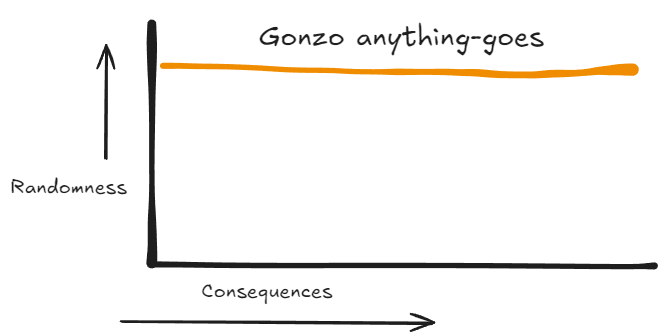
It would be a gonzo anything-goes kind of game, which can turn around on its head almost instantly. Think of the Deck of Many Things combined with Jabberwack in the Elder Scrolls games, where you’d roll for how many petals on that flower as well as the motivations of the big bad evil one.
I’ve played one or two games like this and it’s genuinely fun, at least for a while, but nothing you do has consequence. When everything’s left a chance, there’s no more skill involved than a game of snakes and ladders.
0% Random
The opposite of our utterly random game would be something where there’s very little randomness at all, where regardless of the stakes, there’s very little left to chance.
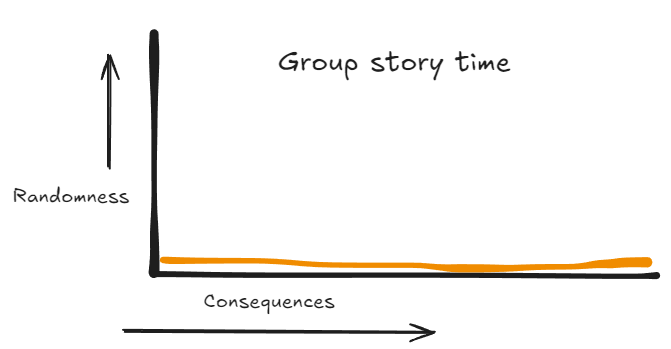
This would be the kind of game which is getting close to being group story time, where the group are narrating what their characters do in response to each other.
This is cool and an interesting form of the game, but it can feel a bit like a writer’s room where there’s no surprises, where there’s no curve balls that take the story in an unexpected direction.
Increasing randomness with consequnces
Those two were the straightforward scenarios. What happens if randomness increases as the consequence increases?
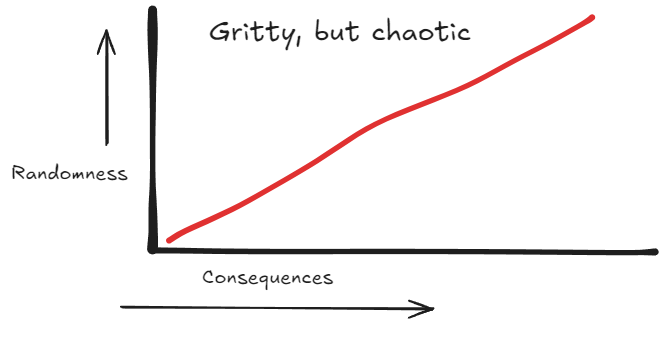
Where events in the game which are low consequence, they don’t get a dice roll, but we save that for the biggest, most important stuff. With small decisions, this might feel quite gritty. This might feel like a game where the characters and Game Master have quite a lot of control, but as the consequences of actions rise, the randomness increases as well.
This would give you a game which could change dramatically with a snap of a finger. Where introducing the deck of many things into a high stakes encounter could cause things to go in a completely different direction.
I’ve played a couple of games like this and it can give an interesting feel, where despite your characters doing their best, they have no control over the wider universe. So this game can feel quite gritty, but also very chaotic as well.
Decreasing randomness with consequences
Let’s see what happens if we flip that line the other way up.
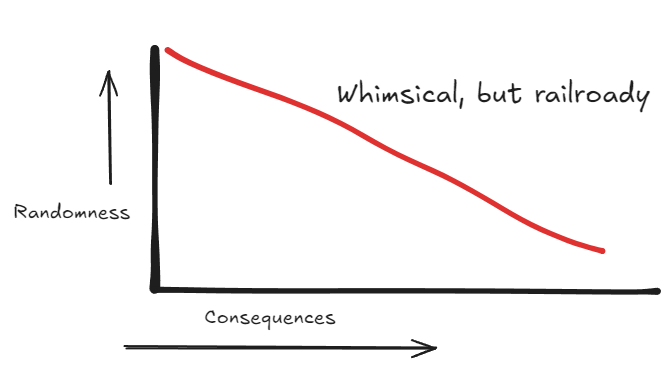
So we have high randomness for low stakes events, but we keep it much more controlled for those high stakes moments. A game like this could feel very whimsical and silly. Let’s roll for how many cats are stuck up the tree.
But when it comes to the bigger moments where the consequences are huge, this is left to the Game Master and the players to decide. This is the kind of game that works well playing with young kids, or people completely new to role playing games. It gives that space for something to be whimsical, but keeps the game on rails a bit to make sure that the group gets through the session.
This is actually exactly the kind of game that I’ll run with my niece and nephews, who are very much kids and not necessarily ready for a full game.
Rich’s Happy Curve
Lastly, we get to Rich’s Happy Curve, which was a working title, but I couldn’t think of anything better. So we’re sticking with this.
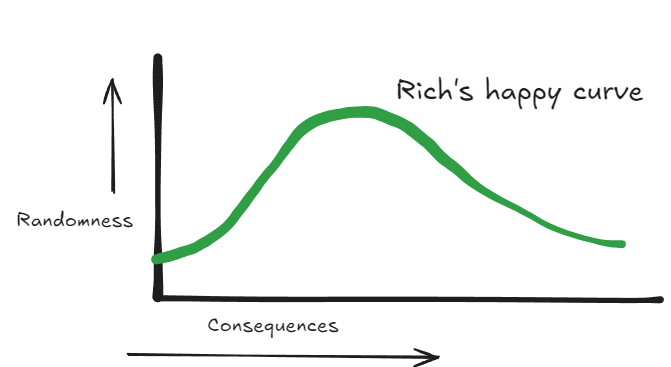
For me, this represents that best of both worlds, where we have randomness, we have consequence to action, but in a way that I found works well at my tables. For events in game with very low consequence, I don’t think there’s much point in rolling.
Likewise, at the high end with very consequential events, I want the Game Master and the players to have control over a lot of that, so that they have to live with the consequences of what they’ve chosen to do, rather than saying, “Oh, it was just bad luck.” No, you own this. This is on you, players.
The space that this leaves for randomness to come to the fore is in that middle ground at the centre of the chart. This is for mid-consequence events, and scenarios like combat or social conflict are perfect to use a lot of dice and introduce a lot of uncertainty into events. Fortunately, at least for the combat side, many, many, many TTRPG systems have all you need to run interesting, but still uncertain and randomised combat.
For social conflict, it’s often left a bit more to the GM’s own preferences on how they want to run that, but highly recommend looking to give as much uncertainty as you can into these situations. I quite liked running social encounters as skill challenges for exactly this reason, where even if in the roleplay side your players give a wonderful speech, it’s a stirring moment.
It could be the person they’re speaking to had a really bad day and just needed coffee, so was not in a mood to listen to anything they had to say, so I don’t mind using dice as well as roleplay to determine the outcome of these encounters.
The place I wouldn’t use that high level of randomness would be in that higher level of consequence. In D&D terms, I wouldn’t roll randomly to decide who the big bad evil one chooses to attack with a Power Word Kill spell. I’d do my best to make it very clear from the start who they really hate and who they’re going to go after. Leaving that to chance deprives you of roleplay opportunities and deprives the group of making interesting tactical choices.
Luckily, I’m not the only one who’s been pondering the problem of randomness. I’ve been reading… a book!
A book full of wisdom
Welcome to Rich’s Cosy Corner, where I try and fail to read all of the books behind me before buying new ones.
Today we have Venger’s Guide to Mastering Chaos at the Table – Run Tabletop Roleplaying Games with Confidence by Scott C. Docherty.
Scott is best known for making awesome maps, including the one from my five room dungeon, which was part of the Dungeon Tuber’s Dungeon Jam.
But he’s also an author, and he sent me a copy of this book, which I thoroughly enjoyed.
He says so many things in here, which really do sit well with my philosophy on running games in general, but specifically on randomness and how to make random encounters more interesting.
The things I think are key in a book, which I’ve not really seen written about elsewhere, is the book gives random encounters a simple but powerful structure.
So often a random encounter table will just list the actors in the scene. They’ll stop at step one of the process. It’ll just say something like “d4 wolves”.
Okay, it’s not bad, but there’s a lot more we can do with this.
The book gives a lot of guidance on how to take this and run with it. Holding your hand through the entire process. It takes you through four steps of creating these encounters. From the hook, the conflict, the resolution and the twist. And for anyone who knows about storywriting or scriptwriting, these are classic elements of the way that stories get put together.
So to see these elements used and tied in so neatly to what can often be seen as the opposite of storytelling in randomness, this is fascinating to me. The first half of the book is a bit of philosophy, all about Scott’s thinking on randomness and how to embrace the chaos at the table, while the second half has a list of a hundred different random encounters for fantasy and sci-fi settings.
And one part that really resonated with me goes like this:
“More crucially, rather than being something the dungeon or game master meticulously plotted out in advance, isn’t story something you tell after the experience is over.”
This ties nicely into the one of the warnings I have to say when I’m talking about storycrafting in TTRPGs. Story is what happens afterwards. All we can do at the table is create situations and react to what happens. If we begin our game thinking “oh we’re going to tell a great story” we’re going to be disappointed.
In the same way as if you went on holiday with some friends and said “we’re going to have such great story to tell after this” you’re likely to be putting yourself in very false and contrived situations rather than just going with the flow and seeing where the adventure takes you. The story is what we get to tell afterwards with a combination of all of these crazy events.
Venger’s Guide to Mastering Chaos at the Table is out now. Highly, highly recommended from me. I read it from cover to cover and thoroughly enjoyed it. If you go pick it up, tell him I sent you.
Putting all this into action
Everything so far has been really nice in theory but how do we apply these principles in practice?
Random tables and random encounters that you are presenting to your players should always maintain player agency. An example where agency is taken away from the players is we see tables for carousing and the results will be something like “you wake up married”, it’s funny but it doesn’t always feel good.
A better way is to give players choices at every step along the road.
As GM we could say something like “hey there’s blackjack and hookers over there in that casino, do you guys want to go there?” By splitting up this big event into smaller chunks where there are decisions at each point along the way, you are maintaining that player agency and you’re allowing them each moment to think about what their character would do rather than just imposing something big upon them.
A question like “what colour shoes is the elf wearing?” It’s probably not worth your time rolling on the table for or overthinking in general. If it’s going to be plot relevant then yeah sure but most of the time you and your players will have something in mind and if it doesn’t come up it’s not important.
An extension of this which other people might disagree with me on is I find it boring to roll randomly for weather. Usually I’ve got something in mind for the weather but to be honest I don’t often think about it. I live in Glasgow in Scotland so my default weather is probably cloudy and rainy.
I’ve noticed that kind of vibe can colour some of the adventures I’ve come up with but then when the sun finally comes out that’s a wonderful thing and a moment that I quite enjoy scripting.
As for using random tables or random chance in general for huge world-changing stuff mid-session I’m honestly not a fan but I have a feeling I’m probably in the minority here. The deck of many things has such world-changing power. I feel it undermines that shared world building that the group may well have done so far. The randomness along with the earth-shattering consequences for me takes something which should feel epic and makes it feel silly. To me it makes it feel less impactful.
Using a table to think about the motive for the big bad evil one is a great part of your session and campaign prep but unless you are comfortable in your game going in an entirely different direction I wouldn’t recommend doing this at the table.
Random tables can be so much more than just a list of actors in a scene. Also use them to give a mood, a vibe to a person, a location and not just stating what the party find. One of my particular favourites when rolling on a random table is delayed gratification for me as the game master. If I roll up a spy on the table it shouldn’t be that the spy suddenly pops up and says:
“ha ha I’ve been tracking you for weeks!”
It should be that first indication that something might be up. Maybe the party see a shadow on the rooftop just for a moment and then it’s gone.
Lots of systems encourage a game master to start a clock, especially Powered by the Apocalypse ones. In Daggerheart this is something that you as GM could spend a Fear token on.
Following these tips and thinking again about the use of randomness in our games should get you a long way towards making it work for you and your table. But even with the best will in the world there are lots of ways your campaign can still unravel without you obviously doing anything wrong.
This post looks at the perils of trying to find impactful stories in high level play. While this one here turns the idea of winning in TTRPGs on its head.
I’ll see you there, maybe…